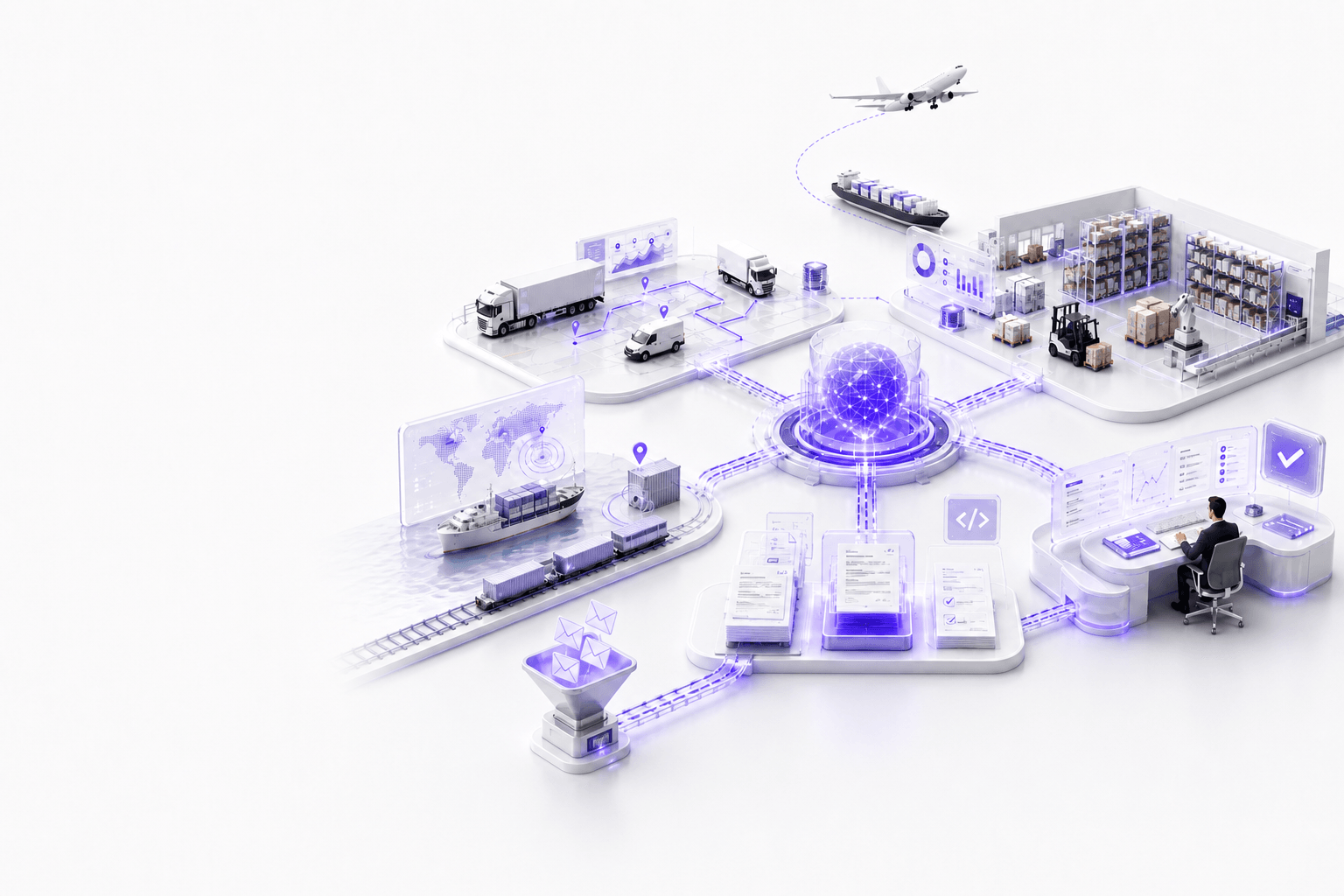
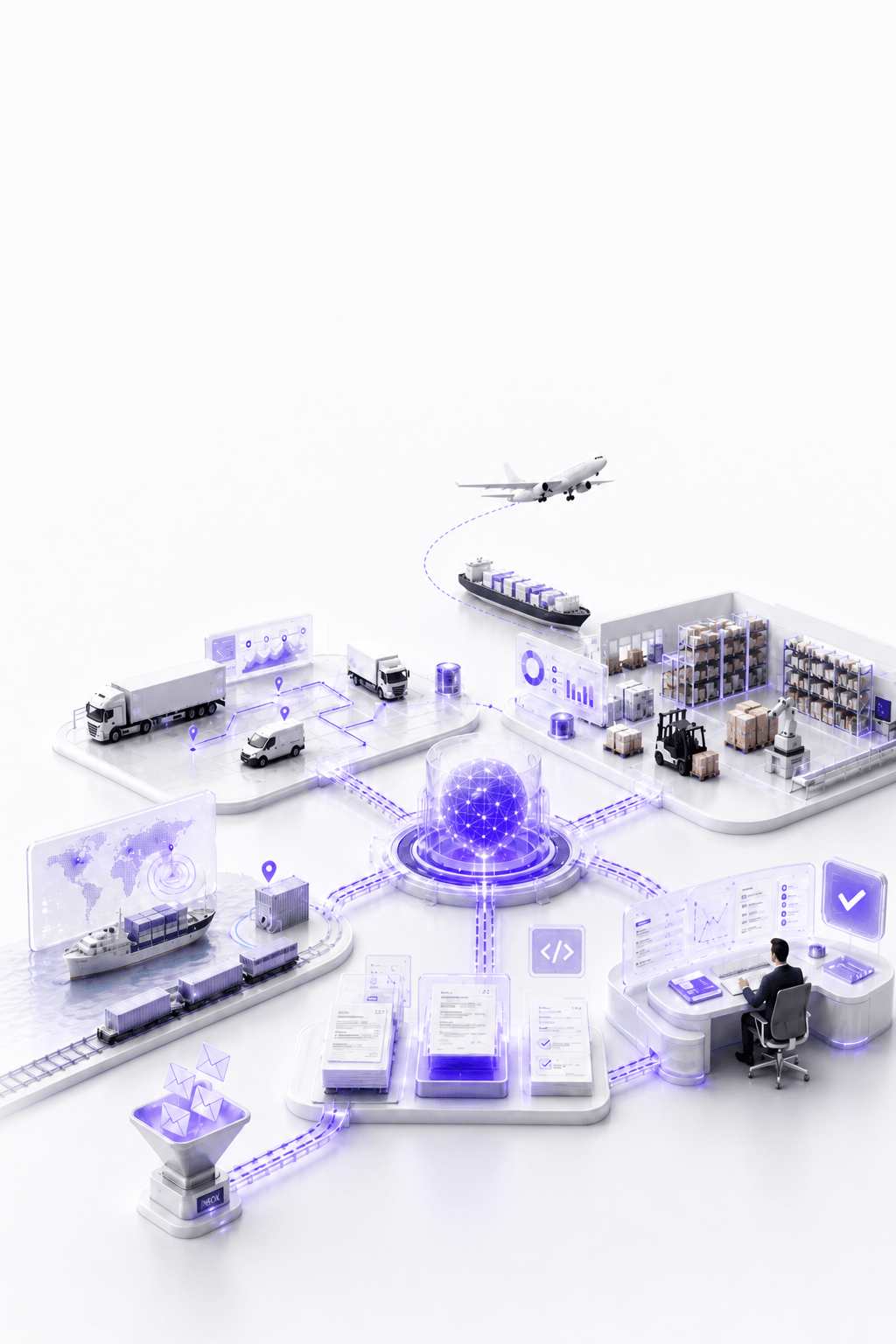
We engineer logistics AI systems for documents, agents and copilots that connect to TMS, WMS, inboxes and documents—with permissions, audit trails and human review where logistics teams need control.
Direct answer
What is logistics AI development?
Logistics AI development engineers production AI systems for docs, agents, and copilots—with permissions, audit trails, and human review—connected to TMS, WMS, inboxes, and document stores logistics teams already trust.
- AI document processing for logistics PDFs and email intake
- AI agents and copilots with TMS and WMS tool access
- Human-in-the-loop review on customer-facing and financial actions
- Exception detection and operational dashboard integration
- Audit trails, permissions and production monitoring
Who this is for
Teams drowning in logistics documents and status email
Operations leaders piloting AI agents with clear escalation paths
Product teams embedding copilots into logistics platforms
Networks ready to automate triage without bypassing approvals
What this solves
- 01
We integrate AI into existing logistics stacks instead of standalone chat experiments that never reach the floor or customer service queue.
What we can build first
AI document intake and validation for logistics
Agent workflows for status, exceptions and customer requests
Copilots for dispatch, customer service and ops teams
Knowledge search across TMS data and internal runbooks
Automation layers with logging and human handoff
How 4RTY helps
Process mapping
Product design
UX and UI
Technical architecture
Development
Integrations
Launch support
Documentation
Systems we integrate with
Delivery & scale path
MVP
Start with a focused release
- AI workflow scoping: Define allowed actions, data sources, guardrails and success metrics.
- Pilot build: Ship one high-volume workflow with logging and review queues.
- Integration: Connect permissions, TMS tools, monitoring and escalation.
- Production rollout: Expand to additional teams, documents and operational use cases.
Scale
Expand after launch
- Automation layers with logging and human handoff
FAQ
Common questions
Can logistics AI connect to our TMS and WMS?
Yes. 4RTY builds logistics AI development workflows with tool access to your transport management system, warehouse management system and document stores so classifications, extractions and agent responses reflect operational truth. Outputs route to review queues or structured TMS updates with audit trails rather than uncontrolled writes, and human-in-the-loop approval remains on customer-facing messages and high-risk financial actions.
Do you build AI agents for logistics customer service?
Yes, with guardrails. Agents handle repeatable status lookup, document retrieval and triage while humans retain control on exceptions, approvals and sensitive customer decisions. We scope allowed tools, log every action, measure correction rates after supervisor edit, and integrate with the inbox and portal workflows customer service teams already use.
What is a practical first logistics AI use case?
Document processing and inbox classification are strong first candidates, bounded inputs, measurable handling time, and clear integration back to TMS shipment records. Start with one document type or intent class, validate data quality on real scans and emails, then expand to additional carriers, languages or agent actions after pilot stability through peak volume.
How is logistics AI different from rules automation?
Rules automation fits stable, well-defined conditions such as milestone triggers and EDI acknowledgements. AI adds flexible interpretation for unstructured documents, email and free-text carrier updates, always paired with confidence thresholds, quarantine paths and logistics team review. Many production workflows combine both: rules for deterministic steps and AI for intake and triage.